%20(1).png?width=265&height=96&name=www.smartenergyanswers.com.auhs-fshubfsSmart%20Energy%20Answers%20Logo%20(HIRES)%20(1).png "Smart Energy Answers Logo")
Electricity bills keep climbing, and renters across New South Wales are feeling the impact just as much as homeowners. The difference is that renters often feel stuck. They do not own the property, so decisions about solar panels and battery storage are usually out of their hands. However, the landscape is evolving, and understanding how renters might access the benefits of the solar battery rebate in NSW (which now operates under the federal scheme) is becoming increasingly relevant. At Smart Energy Answers, we get this question a lot, so let us break it all down clearly.
What Is the Solar Battery Rebate in NSW?
While often referred to locally as the solar battery rebate in NSW, the primary support now available is the Cheaper Home Batteries Program. This program provides financial incentives for eligible installations to help residents reduce the upfront cost of battery storage.
Under this scheme, the installation discount is not a flat amount; rather, the figure changes based on the battery size. Additionally, there are incentives for connecting that battery to a Virtual Power Plant (VPP). It is important to note that the current NSW VPP incentive depends on the usable capacity of the battery, with larger batteries up to 28 kWh receiving a larger incentive. The actual amount can also vary depending on the VPP provider and contract. Furthermore, the VPP incentive can be claimed once per National Metering Identifier (NMI), rather than being a recurring claim every three years.
These incentives are designed to make battery storage more accessible and to support broader clean energy goals. The program provides financial incentives for eligible installations, and understanding who can access it matters a lot.
Can Renters Apply for This Rebate Directly?
As it stands, the rebate is tied to the installation of a battery at a property. Since renters do not own the property, they generally cannot apply for the rebate themselves without landlord approval.
The rebate is accessible to property owners, including landlords, subject to program eligibility criteria. So if a renter wants to benefit, the conversation really needs to start with the landlord.
However, renters may still benefit indirectly. There are a few real pathways worth knowing about.
How Renters Can Still Benefit
Renters are not without options. Here are some practical ways the current battery rebate landscape can still work in their favour:
-
Talk to your landlord: If a landlord installs a battery using the available federal rebate, the property becomes more energy efficient. Renters in that home can benefit from lower electricity costs as a direct result.
-
Negotiate as part of your lease: In places like Sydney, Wollongong, and Newcastle, where rental competition is high, landlords are starting to see solar and battery systems as a selling point. It is worth having the conversation.
-
Strata and apartment schemes: The NSW Government has also launched the Solar for Apartments Scheme. This is opening doors for renters in strata buildings who have historically had no access to rooftop solar at all.
-
Community energy programs: Some VPP arrangements and community battery trials are exploring models that include renters directly.
The Role of Aiko Solar Panels in a Complete System
If a landlord does decide to invest in solar and battery storage, the quality of the solar panels matters just as much as the battery itself.
At Smart Energy Answers, we install Aiko solar panels as part of our Smart Solar service. Aiko solar panels use advanced Smart ABC technology, which means they continue generating power even in partial shade or during high temperatures. For homes in Sydney's western suburbs or coastal areas where weather varies, this kind of reliability is a real practical advantage.
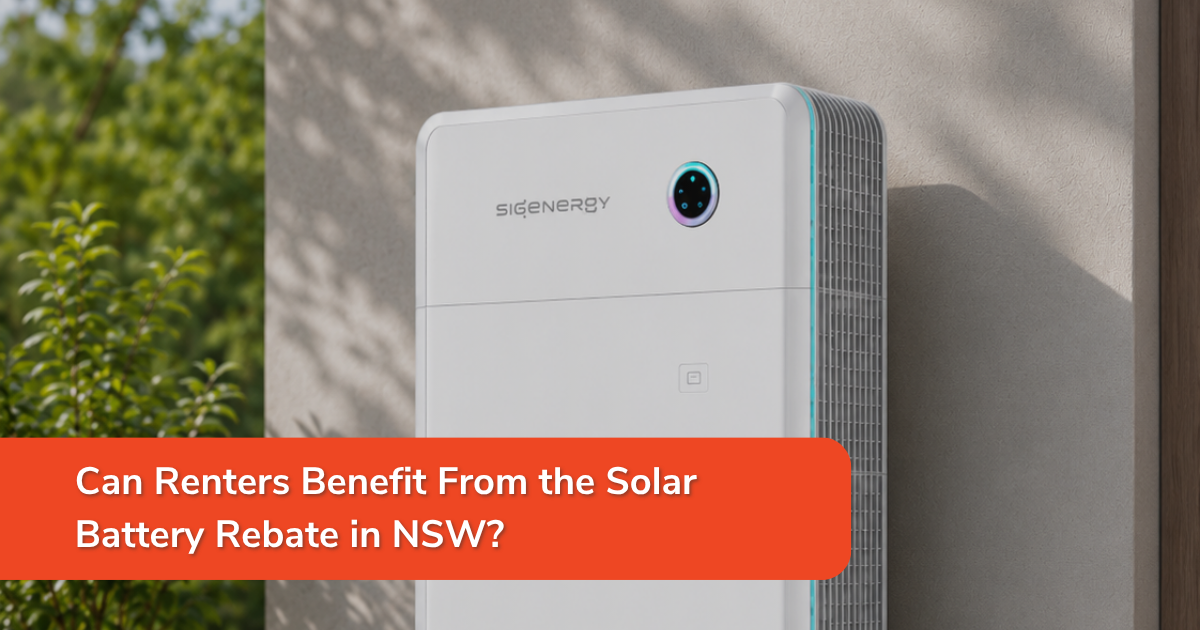
When Aiko solar panels are paired with a quality battery like the Tesla Powerwall 3 or a Sigenergy battery, the whole system works together to maximise energy capture and storage. This means more of the sun's energy gets used within the home rather than going back to the grid, which translates directly to lower electricity bills for whoever is living in that property, including renters.
What the Federal Battery Rebate Could Mean for Renters
The primary support mechanism is the federal scheme. The Australian Labor Government has announced the Cheaper Home Batteries Program, which offers a rebate based on battery capacity for eligible installations.
If landlords can access this federal incentive, the case for installing solar and battery storage becomes much stronger financially. That is good news for renters, because the lower the landlord's upfront cost, the more likely they are to make the upgrade.
Why Getting the Right Advice Matters
Navigating battery rebates is not always straightforward, especially for renters trying to make a case to their landlord. At Smart Energy Answers, we have completed over seven thousand solar installations across Australia and hold multiple national retailer awards. We work with clients in Sydney, Central Coast, Newcastle, Wollongong, and across NSW to find practical solutions that suit each property.
Whether you are a renter wanting to have an informed chat with your landlord, or a property owner considering the upgrade, we are here to help. The right system with quality products and a trusted battery brand can provide long-term energy cost savings, and we can walk you through every step of the process.
Frequently Asked Questions

.png?width=514&height=121&name=Tesla%20Powerwall%203%20(new).png)






.webp?width=300&height=180&name=sigenergy-gold-installer-300x180%20(1).webp)